Atlas Copco Launches Integrated Hybrid Generator Range, Designed to Cut Fuel Use, Lower Emissions and Costs
Companies are under increasing pressure to reconcile sustainability requirements with practical operational needs. Customers, regulators and project owners are demanding measurable reductions in emissions and fuel consumption. Commercial realities, however, dictate that equipment must be easy to deploy, simple to operate, reliable in harsh conditions, and profitable across every rental cycle.
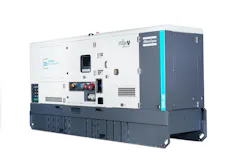
Atlas Copco’s new QHS Integrated Hybrid Generators are designed to enable rental fleets to deliver reliable, lower-emission power without adding operational complexity, the company said. Combining diesel engine and battery technology into a single, all-in-one canopy unit, QHS integrated hybrid generators reduce fuel consumption and CO₂ emissions while supporting fast installation, autonomous operation and high utilization.
“Attitudes to energy consumption are changing rapidly, but customers still need solutions that work in the real world,” said Sergio Salvador, vice president marketing portable power. “We are focused on developing solutions that offer customers the best practical low-carbon option. Our new QHS Integrated Hybrid Generators are designed to help fleets deliver lower emissions and lower fuel consumption without sacrificing uptime, simplicity or transport efficiency.”
Integrated hybrid generators are engineered to respond to common operational challenges experienced across construction sites, events, utilities and industrial rental applications. Their ability to automatically manage energy from different sources minimizes unnecessary engine runtime and fuel consumption at low and variable loads. Compared with conventional diesel-only operation, integrated hybrid generators can deliver up to 80-percent fuel savings, reduce CO₂ emissions by up to 80 percent, and cut engine runtime by more than 95 percent, the maker said, lowering operating costs while supporting customer sustainability goals.
Designed specifically for industrial rental fleets, the integrated hybrid generators simplify hybrid power by integrating key components – the diesel engine, battery technology, power electronics and intelligent energy management – into one compact unit. This all-in-one canopy design reduces transport requirements, speeds up installation, and supports high utilization throughout the rental cycle.
Rental-ready features include multiple socket options, a terminal board, external fuel connections, and FleetLink telemetry for remote monitoring, diagnostics and proactive fleet management. Operators can deploy the unit quickly, monitor performance remotely, and maximize uptime while reducing the operational workload for field teams.
Less maintenance, better TCO
QHS Integrated Hybrid Generators are engineered to deliver measurable cost reductions for businesses. By dramatically reducing fuel consumption and cutting generator runtime, these units lower operating expenses and help extend the working life of key components. Reduced runtime also means fewer service interventions, less wear and tear, and longer service intervals, supporting lower maintenance costs and stronger long-term fleet economics.
“By integrating battery technology and diesel engines into one compact unit with simple, intuitive controls, we’re making hybrid power easier to deploy, easier to operate and easier to rent,” said Tony Calippe, marketing manager power & light. “Our new QHS generators offer rental companies a practical way to support customer sustainability goals, cut operating costs, improve fleet efficiency and reduce total cost of ownership.”
Intuitive operation
QHS integrated hybrid generators are designed with the end user in mind. Ease of operation are at the heart of these machines. With engine and battery power available at the press of a button, operating the integrated hybrid generators is straightforward and intuitive. A one-click start/stop interface and fully autonomous operating mode allow QHS generators to adapt to changing load profiles without user intervention, minimizing training requirements and operational errors. Fewer maintenance intervals allow for faster project completion, and issues caused by wet stacking and low loads become a thing of the past.
The Atlas Copco ECOController specifically designed for hybrid power systems serves as the heart of the system, providing access to smart energy management at users’ fingertips. Switching between engine and battery power, the interface ensures optimized performance across all applications. The controller automatically selects the most efficient power source and delivers power to the load accordingly. Whenever the generator is running, the energy management software prioritizes supplying power to the load and then uses any surplus energy to charge the battery, ensuring efficient operations at all
For more information about QHS Integrated Hybrid Generators, visit QHS Integrated Hybrid Generators.
About the Author
Michael Roth
Editor
Michael Roth has covered the equipment rental industry full time for RER since 1989 and has served as the magazine’s editor in chief since 1994. He has nearly 30 years experience as a professional journalist. Roth has visited hundreds of rental centers and industry manufacturers, written hundreds of feature stories for RER and thousands of news stories for the magazine and its electronic newsletter RER Reports. Roth has interviewed leading executives for most of the industry’s largest rental companies and manufacturers as well as hundreds of smaller independent companies. He has visited with and reported on rental companies and manufacturers in Europe, Central America and Asia as well as Mexico, Canada and the United States. Roth was co-founder of RER Reports, the industry’s first weekly newsletter, which began as a fax newsletter in 1996, and later became an online newsletter. Roth has spoken at conventions sponsored by the American Rental Association, Associated Equipment Distributors, California Rental Association and other industry events and has spoken before industry groups in several countries. He lives and works in Los Angeles when he’s not traveling to cover industry events.