Sage Oil Vac Shows New High-Capacity Tanks at Work Truck Week
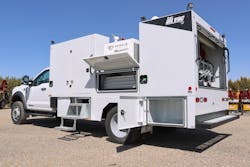
Customers and the media got their first look at new high-capacity tanks and other options available on Sage Oil Vac’s new premium non-CDL open lube truck at Work Truck Week in Indianapolis. The truck was on display at the show, March 10-13.
Designed on the Ford F-600 chassis, this upgraded lube service truck offers more fluid capacity than the standard Sage Oil Vac non-CDL open lube truck, helping operations avoid the expense, insurance and licensing of a CDL-size vehicle. The extra fluid capacity means technicians can service more equipment in a single trip and stay longer on the job. And the size of the pickup-style, F-600 platform boosts jobsite maneuverability. In many cases, crews can take the truck to the equipment rather than bring the equipment to the truck.
Using Sage Oil Vac’s exclusive pump-free technology, the truck delivers faster, cleaner fluid service with fewer moving parts, making it a highly efficient solution for demanding environments such as construction jobsites. It is built with the operator in mind, featuring practical upgrades like a standard power washer, radar tank sensors for more accurate fluid monitoring and a PTO-driven compressor.
Pump-free advantage
Powered by Sage Oil Vac’s exclusive pump-free system, technicians use vacuum pressure to transfer fluids quickly and reliably without mechanical pumps — reducing maintenance, minimizing downtime and simplifying operation.
Higher capacity without CDL requirements
The truck delivers 620 gallons (2,347 L) of fresh fluid capacity — 220 gallons (833 L) more than the standard Sage Oil Vac non-CDL open lube truck — allowing technicians to complete more services on the jobsite before returning to refill fluids or dispose of waste oil, all while remaining under CDL requirements.
PTO compressor
The truck uses a PTO-driven compressor, giving operators the flexibility to power the system in the way that best fits their operation.
Standard power washer
A built-in power washer helps technicians remove mud and debris from equipment before or after servicing. As an option, the washer can be removed and replaced with an additional oil tank for more fluid capacity.
New radar tank sensors
Integrated radar sensors provide more accurate fluid level readings and make monitoring tank levels easier for operators, eliminating the risk of over- or under-filling reservoirs.
Designed for heavy equipment service
The added fluid capacity helps technicians efficiently perform larger service intervals, such as 500- or 2,000-hour maintenance on construction equipment.
About the Author
Michael Roth
Editor
Michael Roth has covered the equipment rental industry full time for RER since 1989 and has served as the magazine’s editor in chief since 1994. He has nearly 30 years experience as a professional journalist. Roth has visited hundreds of rental centers and industry manufacturers, written hundreds of feature stories for RER and thousands of news stories for the magazine and its electronic newsletter RER Reports. Roth has interviewed leading executives for most of the industry’s largest rental companies and manufacturers as well as hundreds of smaller independent companies. He has visited with and reported on rental companies and manufacturers in Europe, Central America and Asia as well as Mexico, Canada and the United States. Roth was co-founder of RER Reports, the industry’s first weekly newsletter, which began as a fax newsletter in 1996, and later became an online newsletter. Roth has spoken at conventions sponsored by the American Rental Association, Associated Equipment Distributors, California Rental Association and other industry events and has spoken before industry groups in several countries. He lives and works in Los Angeles when he’s not traveling to cover industry events.