Perkins Tests New Hydrogen Hybridized IOPU
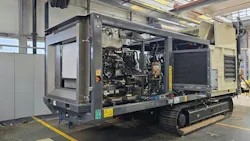
Designed as a direct replacement for a diesel engine IOPU, the new hydrogen hybrid Industrial Open Power Unit has completed extensive development testing and is now being fitted into Terex’s Ecotec TDS 820 shredder to further test the hybrid IOPU’s capabilities in the field.
“Demonstrating in machine is a key milestone for the team,” said Andy Curtis, customer solutions director at Perkins. “Showing the system operating in a real-world application recognizes the progress made over the past two years. From early in the project, we knew we wanted to work with Terex and its Ecotec environmental equipment business.
“Terex is one of the world’s leading OEMs for mobile wood processing, biomass and recycling equipment – which we believe is a great fit for the hybrid IOPU. We were delighted when they accepted our proposal and we’re now working together at our research and development facility in Peterborough to install and demonstrate the system.”
Project Coeus is a three-year project that has seen Perkins partner with e-powertrain specialists Equipmake and Loughborough University’s Wolfson School of Mechanical, Electrical and Manufacturing Engineering to develop an innovative, advanced fuel-configurable hybridized IOPU. The project is supported by UK Government funding of £11.14M through the Advanced Propulsion Centre UK (APC).
The four fuels selected for inclusion in the project – ethanol, methanol, bio-methane and hydrogen – have one characteristic in common: they are all spark-ignited fuels. To utilize these fuels, Perkins has created a configurable spark-ignited combustion platform on which the project relies.
The project has developed a hybridized IOPU to deliver a robust and trusted fuel-configurable plug-and-play solution that produces reliable performance and is designed to meet global emissions standards, ensuring flexibility for the user.
"Ecotec equipment processes waste materials such as wood waste, biomass and construction debris, helping customers recover reusable resources and reduce reliance on landfill," said Conor Hegarty, business line director for Ecotec. "While our products are already making a positive environmental impact through the work they perform, we're continually innovating to make the machines themselves more sustainable. Projects such as Coeus allow us to explore lower-emission technologies that can help meet future environmental requirements while continuing to deliver the power, reliability and productivity our customers expect from Ecotec equipment."
“The Peterborough Customer Machine Engineering Team (CMET) are currently integrating the hydrogen hybrid engine into the high-performance shredder,” said Curtis. “Once that work’s complete, the machine demonstrator will undergo a series of tests at our proving site. We’ll be looking to demonstrate the proof of technology concept and that it achieves the peak load demands and transient response requirements of the machine.
“The machine demonstrator will also help us define how to handle and utilize hydrogen within a real-world jobsite environment. This learning will allow us to support our customers’ machine development goals during future project phases.”
Based on the Perkins 1200 Series platform, the 1206 hydrogen hybrid IOPU is engineered to deliver a total of 379 kW (508 hp) – made up from the engine and the integrated motor generator unit, which boosts performance – and 1938 Nm at 1200-1500 rpm. The advanced hybrid cooling system is designed to reduce fuel consumption and noise from the IOPU by utilizing on-demand cooling technology.
The work, the first application of Project Coeus, is being carried out by Perkins’ Customer Machine Engineering Team at its research and development facility in Peterborough, after which the demonstrator will undergo a series of tests at Perkins’ proving site. These will demonstrate the proof of technology concept, including the system’s ability to meet the peak load demands and transient response requirements of the machine.
At the core of the hybrid power unit is an entirely new spoke architecture heavy duty electric motor, custom designed and developed in-house at the company’s facility in Snetterton, Norfolk, UK. Combined with the company’s own silicon carbide inverter technology and all associated power electronics, Equipmake has been responsible for integrating this new motor generator unit with a spark-ignited Perkins engine to boost performance. Based on the Perkins 1200 Series platform, the 1206 hydrogen hybrid IOPU delivers a combined 397 kW (508 hp) and 1,938 Nm at 1,200-1,500 rpm.
Plug and play solution
Packaging this level of electrified performance within a unit designed as a direct replacement for an existing diesel IOPU is central to the project’s aims. By offering a robust ‘plug and play’ solution, the technology is intended to allow off-highway OEMs to accelerate their transition to lower carbon fuels and electrification without the need to fundamentally redesign their machines.
“This is a proud moment for everyone at Equipmake,” said Ian Foley, Equipmake CEO. “Our role in Project Coeus has been to deliver a custom-designed heavy-duty electric motor – paired with our own silicon carbide inverter technology and all associated power electronics – and integrate that with a Perkins engine. The resulting hybrid industrial open power unit can cope with the extreme demands of off-highway applications and is packaged so it can sit within a genuine drop-in replacement for a diesel power unit. Moving from the test cell into a machine as demanding as a high-performance shredder is exactly the proving ground this technology needs.
“Off-highway OEMs want to decarbonize without compromising productivity or re-engineering their machines from scratch, and hybridization combined with lower carbon fuels such as hydrogen offers a practical route to doing that. This milestone shows the strength of UK engineering collaboration, and how the electrification expertise we have built in sectors such as bus and coach can be applied to the global off-highway market.”
About the Author
Michael Roth
Editor
Michael Roth has covered the equipment rental industry full time for RER since 1989 and has served as the magazine’s editor in chief since 1994. He has nearly 30 years experience as a professional journalist. Roth has visited hundreds of rental centers and industry manufacturers, written hundreds of feature stories for RER and thousands of news stories for the magazine and its electronic newsletter RER Reports. Roth has interviewed leading executives for most of the industry’s largest rental companies and manufacturers as well as hundreds of smaller independent companies. He has visited with and reported on rental companies and manufacturers in Europe, Central America and Asia as well as Mexico, Canada and the United States. Roth was co-founder of RER Reports, the industry’s first weekly newsletter, which began as a fax newsletter in 1996, and later became an online newsletter. Roth has spoken at conventions sponsored by the American Rental Association, Associated Equipment Distributors, California Rental Association and other industry events and has spoken before industry groups in several countries. He lives and works in Los Angeles when he’s not traveling to cover industry events.