Volvo CE’s A50 Articulated Hauler Wins Red Dot Award for Product Design
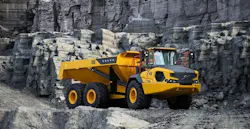
Volvo Construction Equipment has won a Red Dot Design Award for its Volvo A50 articulated hauler. Volvo has gone beyond existing ISO standards to prioritize operator sightlines and safe interaction around the machine winning the Red Dot Product Award for Product Design.
What appears to be a small change on paper was driven by a far more demanding internal requirement, requiring a complete rethink of the vehicle’s proportions and exterior surfaces. The engine hood has been significantly lowered and volumes above the wheels cut away, resulting in exceptional visibility from the cab. Operators can now see people and obstacles positioned much closer to the machine than ever before.
This new human-centric design approach is reflected not only in the A50 itself, but also across its sister models, setting a new standard for safety-led design in this class, while placing increasing demands on both the design and engineering team.
This achievement is the result of close collaboration between design and engineering, working as one team, with a shared ambition to build the best possible hauler.
Nina Augustsson, design director at Volvo CE, said: “This award recognizes years of work to put safety at the heart of articulated hauler design, not as a feature, but as a fundamental design principle. Design and engineering worked as one team from the very beginning. We challenged each other constantly, always with safety, functionality, and serviceability as our starting point. This long-term partnership has made it possible to raise standards, deliver true modularity, and create a product with real character, outstanding quality, and demonstrably higher safety.
“The challenge was to make shared components work across very different proportions while still creating a strong and coherent family identity. When seen together, the smallest and largest haulers are clearly related, despite their dramatic differences in scale.”
“The A50 is not a standalone product, but part of a modular articulated hauler platform with shared components across a wide range of sizes,” said Daniel Tiger, expert system owner articulated haul at Volvo CE Braas. “From an engineering perspective, it brings together diverse stakeholder requirements into a single, best-in-class product concept that delivers in terms of safety, efficiency, durability, environmental performance, and total cost of ownership.”
Intuitive visual guides
The operator is now centrally positioned above the front axle, with clearly defined corners of the machine providing intuitive visual guides that deliver exceptional maneuverability and precision. To accommodate a lifting eye on the engine, a subtle protrusion has been integrated into the hood as a sculpted design feature known as the ‘aim’, which also serves as a sightline marker, providing operators with a precise visual reference when maneuvering.
In cold climates, this detail offers further benefit by guiding meltwater away and preventing ice forming on the front camera. The ‘aim’ perfectly illustrates the design philosophy of transforming technical constraints into purposeful features that enhance usability and safety.
Additional safety features include a new side entrance and a continuous, secure, illuminated walkway with handrails around the cab, making daily checks and servicing safer and more accessible for both operators and technicians. Cameras positioned in the C-Pillar and integrated into the front iron mark address indirect vision limitations, further improving visibility and overall situational awareness.
Inside, the cab has been redesigned to improve layout, storage, and space, introducing a new color palette and materials selected with sustainability in mind. Injection-molded components enable refined surfaces and detailing, delivering a level of robustness and quality well beyond typical industry standards. Ergonomics, from seating and sightlines to control placement, have been carefully developed to create a smarter, more intuitive environment that supports operators and helps reduce fatigue.
About the Author
Michael Roth
Editor
Michael Roth has covered the equipment rental industry full time for RER since 1989 and has served as the magazine’s editor in chief since 1994. He has nearly 30 years experience as a professional journalist. Roth has visited hundreds of rental centers and industry manufacturers, written hundreds of feature stories for RER and thousands of news stories for the magazine and its electronic newsletter RER Reports. Roth has interviewed leading executives for most of the industry’s largest rental companies and manufacturers as well as hundreds of smaller independent companies. He has visited with and reported on rental companies and manufacturers in Europe, Central America and Asia as well as Mexico, Canada and the United States. Roth was co-founder of RER Reports, the industry’s first weekly newsletter, which began as a fax newsletter in 1996, and later became an online newsletter. Roth has spoken at conventions sponsored by the American Rental Association, Associated Equipment Distributors, California Rental Association and other industry events and has spoken before industry groups in several countries. He lives and works in Los Angeles when he’s not traveling to cover industry events.