Specialty Rental, Big Projects Continue Strong in United Rentals’ First Quarter, Flannery Says
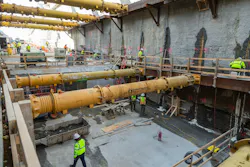
Specialty rental continued to be a leading driver of business for United Rentals in the first quarter of 2026, although the number of cold starts were a bit fewer, United Rentals CEO Matthew Flannery told a conference call of investors. The company did some restructuring with some facility consolidation, and improved operational efficiency yielded estimated cost benefits. An increased capex program was designed to address elevated demand in both the General and Specialty rental categories.
“The momentum we are carrying into our busy season, along with our customers' feedback for their business, supports our expectations this will be another record year, as further evidenced by our updated guidance,” Flannery said. “Within specialty, which grew 14 percent year over year, we saw growth across all lines of business and opened 17 cold starts. By vertical, our construction end market saw strong growth led by non-residential construction and infrastructure. On the industrial side, power and mining and minerals were notable standouts, with power continuing to post double-digit growth. We saw a wide variety of new projects kick off in the quarter, spanning health care, infrastructure, power, industrial manufacturing, and, of course, data centers.”
Flannery said United Rentals expects to be a key partner for the World Cup, beginning in the second quarter. He said the company will be providing support in the general and specialty rental areas for the world’s most important soccer tournament.
United said the used market is continuing to be strong, having sold $680 million of OEC at a 51-percent recovery rate in the quarter, on track to sell approximately $2.8 billion of fleet this year, supported by strong demand for used equipment.
“In conjunction with these sales, we spent $874 million on rental CapEx,” Flannery said. “This was spread across replacement and growth CapEx, with a focus on specialty and bringing in additional general equipment where we see strong demand. Subsequently, we generated free cash flow of $1.1 billion.”
The company is bullish about conditions going forward this year.
“Feedback from the field continues to be optimistic, particularly for large projects,” Flannery said. “We are carrying strong momentum into our busy season and we feel confident we are positioned to win in the marketplace. We see multiyear tailwinds for large projects and believe we are well positioned for these opportunities. And we will continue to monitor and manage our cost structure and operate with capital discipline.”
First quarter record EBITDA
Executive vice president and chief financial officer Ted Grace told the investors EBITDA was extremely strong in the quarter.
“Excluding the $52 million net benefit we realized with the termination of the H&E acquisition in the year-ago period, EBITDA increased $140 million to a first-quarter record of almost $1.76 billion,” Grace said. “This was primarily driven by a $160 million increase in rental gross profit, partially offset by a $12 million decline in used gross profits. Excluding the impact of H&E, SG&A increased $16 million year-over-year but declined as a percent of revenue, while gross profits from other lines of businesses increased $8 million.”
Grace added that the benefit of strong cost management expanded United Rentals’ underlying margins year over year. “While we will always have normal quarter to quarter variability in costs, it remains our goal to achieve flat margins for the full year,” he noted. “Additionally, we took steps across the organization to control variable costs with a significant focus on labor and outside hauling.”
Grace added that the company returned $500 million to shareholders in the quarter: $125 million in dividends and $375 million through repurchases.
Flannery said United spent slightly less than $400 million in the first quarter on acquisitions.
“The deal pipeline remains pretty consistent,” he said. “The real challenge for us is not how many deals to look at — it is how many meet our expectations to do a deal and the returns we expect on a deal, and to get that willing dance partner. But there is no lack of opportunities to look at. We continue to work the pipeline. We have a great M&A team and business development team. We would lean towards Specialty, specifically adding in new products. But we will do tuck-ins as well in the General business if it fills a need and gives us capacity in a growing market. We will continue to work the pipeline.”
Flannery added that the large project pipeline is doing well, with data centers and non-residential construction offering multiple opportunities. “And power continues to grow at double digits. Power has been a really strong end market that we have been focused on for a while now. Those are really the drivers.”
For an indepth view on United Rentals’ first quarter results, visit: https://www.rermag.com/news-analysis/headline-news/article/55372861/united-rentals-first-quarter-2026-rental-revenue-jumps-87-percent-total-revenue-climbs-72-percent