Snow Thrower Safety Tips: Keep Best Practices in Mind This Winter
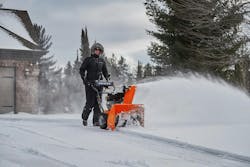
Clearing snow and ice from driveways, sidewalks and parking lots is no small job. People rely on their outdoor power equipment to do the heavy lifting, and it’s important to keep safety in mind. The Outdoor Power Equipment Institute (OPEI) reminds home and business owners to use snow throwers, often referred to as snow blowers, safely and offers tips to help.
“Weather today is unpredictable. You need to have your snow thrower serviced and ready to power up,” said OPEI president and CEO Kris Kiser. “Review your owner’s manual so you can use your equipment safely.” Kiser says preparation is key and that home and business owners should consider the following:
Review the owner’s manual. Check the owner’s manual for safe handling procedures. If the manual cannot be found, look it up online, and store a copy on your computer so it’s available to reference in the future. Review how to operate controls. Be able to shut off equipment quickly.
Check equipment. The snow thrower should be powered off when being checked over. Adjust any cables and check the auger.
Charge batteries. Locate the batteries for your snow thrower and charge them fully before it snows.
Purchase fuel. Be sure to use the correct fuel recommended by the equipment's manufacturer. For most gasoline-powered snow throwers, that is E10 or less. Often fuel stations are closed after a storm so buy gasoline in advance of storms. Fuel that is more than 30 days old can phase separate and cause operating problems. For more information on fueling properly see www.opei.org/programs/ethanolwarning
Store and use fuel properly. Place gasoline in a proper fuel container and label it with the date purchased and the ethanol content. Store fuel safely and out of the reach of children. Fill the fuel tank outside before starting the engine and while the engine is cold. Never add fuel to a running or hot engine.
Clear the area. Snow can sometimes hide objects. Doormats, hoses, balls, toys, boards, wires, and other debris should be removed from areas you intend to clear. When run over by a snow thrower, these objects may harm the machine or people.
Dress for winter weather. Locate safety gear now and place it in an accessible closet or location. Wear safety glasses, gloves and footwear that can handle cold and slippery surfaces when operating the snow thrower.
KEY SAFETY TIP: Never put your hands inside the auger or chute. Use a clean out tool to unclog snow or debris from the snow thrower. Your hands should never go inside the auger or chute.
Turn OFF the snow thrower if you need to clear a clog. If you need to remove debris or unclog snow, always turn off the snow thrower. Wait for all moving parts to come to a complete stop before clearing any clogs or debris.
Operate in visible conditions. Never operate the snow thrower without good visibility or light.
Aim with care. Never throw snow toward people or cars. Keep children or pets inside and away from your snow thrower when it is operating.
Use extreme caution on slopes and hills. Use caution when changing directions on slopes. Do not attempt to clear steep slopes.
Know where the cord is. If using an electric powered snow thrower, be aware of where the power cord is at all times. Avoid tripping.
For more information, contact the Outdoor Power Equipment Institute (OPEI)
About the Author
Michael Roth
Editor
Michael Roth has covered the equipment rental industry full time for RER since 1989 and has served as the magazine’s editor in chief since 1994. He has nearly 30 years experience as a professional journalist. Roth has visited hundreds of rental centers and industry manufacturers, written hundreds of feature stories for RER and thousands of news stories for the magazine and its electronic newsletter RER Reports. Roth has interviewed leading executives for most of the industry’s largest rental companies and manufacturers as well as hundreds of smaller independent companies. He has visited with and reported on rental companies and manufacturers in Europe, Central America and Asia as well as Mexico, Canada and the United States. Roth was co-founder of RER Reports, the industry’s first weekly newsletter, which began as a fax newsletter in 1996, and later became an online newsletter. Roth has spoken at conventions sponsored by the American Rental Association, Associated Equipment Distributors, California Rental Association and other industry events and has spoken before industry groups in several countries. He lives and works in Los Angeles when he’s not traveling to cover industry events.