Mattracks TD300 Rubber Track System for Road Graders Designed for Soft Terrain
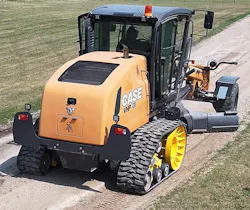
Mattracks has introduced the TD300 (Tandem Drive) heavy-duty rubber track conversion system engineered specifically for road graders operating where tires fail, and steel tracks fall short.
Designed for soft, sandy, and unstable terrain, the TD300 Tandem Drive grader track system enables full grading capability in environments where wheeled machines typically stall. With a current gross vehicle weight rating of 30,000 pounds, and engineering capability extending beyond 40,000 pounds for larger platforms, the system opens new operational territory for construction, infrastructure, energy, mining, and military support operations.
The TD300 system was developed in response to a real-world challenge. A customer approached Mattracks needing to grade sandy desert terrain where pneumatic tires repeatedly sank, stalled production, and compromised surface quality. No viable off-the-shelf solution existed.
Rather than avoid the application, Mattracks engineered one.
The result is the TD300 Tandem Drive rubber track conversion, purpose-built for road graders, adapting proven industrial track technology to a machine category few manufacturers have attempted.
Floating bearing, hub-mounted
Unlike conventional track designs, the TD300 Tandem Drive system utilizes a floating bearing, hub-mounted drive architecture, a configuration rarely used in track systems and not previously applied at this scale for graders, the company said.
This design:
- Drives the track from a single axle, eliminating torsional stress and track folding.
- Distributes load across both drive axles for improved stability and balance.
- Maintains a true hub-mounted, plug-and-play installation.
- Preserves grader geometry while increasing ground contact area.
“For grading, flotation and consistency matter more than obstacle clearance,” said Jon Vacura, engineer at Mattracks. “The goal isn’t climbing, it’s staying level, maintaining traction, and producing a uniform surface. Increasing the footprint directly supports that.”
Eliminating tire bounce
Beyond flotation and traction, the TD300 addresses another long-standing challenge in grading operations: surface inconsistency caused by pneumatic tire bounce that results in a washboard road — the very condition a grader is designed to eliminate.
Pneumatic tires react to surface depressions by compressing and rebounding. This repeated compression introduces oscillation into the machine, which transfers directly to the blade. The result is uneven grading, reduced surface quality, and operators being forced to slow down to maintain acceptable results, ultimately impacting productivity.
Rubber tracks are designed to span surface depressions rather than dropping into them. This allows the grader to maintain a more consistent ride height, delivering smoother blade control and a more uniform finished surface.
“In grading, the machine is actively flattening the surface,” Vacura said. “Tracks span depressions instead of reacting to them, which helps maintain a consistent grade and reduces the need to slow down to control bounce.”
Improved flotation and traction
Operators using the TD300 Tandem Drive system can expect immediate advantages, including:
- Substantially improved flotation and traction in sand, loose soil, and soft ground.
- Reduced surface disturbance compared to tires or steel tracks.
- Smoother grading results because of reduced machine bounce.
- Extended work windows after rain or in sensitive terrain.
- Lower downtime and fewer recovery delays.
- Improved jobsite access and schedule reliability.
Rubber tracks also offer environmental benefits over steel alternatives, delivering controlled compaction and significantly lower ground pressure, critical for solar installations, infrastructure corridors, and protected areas, the company said.
About the Author
Michael Roth
Editor
Michael Roth has covered the equipment rental industry full time for RER since 1989 and has served as the magazine’s editor in chief since 1994. He has nearly 30 years experience as a professional journalist. Roth has visited hundreds of rental centers and industry manufacturers, written hundreds of feature stories for RER and thousands of news stories for the magazine and its electronic newsletter RER Reports. Roth has interviewed leading executives for most of the industry’s largest rental companies and manufacturers as well as hundreds of smaller independent companies. He has visited with and reported on rental companies and manufacturers in Europe, Central America and Asia as well as Mexico, Canada and the United States. Roth was co-founder of RER Reports, the industry’s first weekly newsletter, which began as a fax newsletter in 1996, and later became an online newsletter. Roth has spoken at conventions sponsored by the American Rental Association, Associated Equipment Distributors, California Rental Association and other industry events and has spoken before industry groups in several countries. He lives and works in Los Angeles when he’s not traveling to cover industry events.